
Retro Tapes 2 RTP/Volatility
Retro Tapes 2: RTP and Volatility Explained
Understanding Return to Player (RTP) and volatility is essential for setting realistic expectations before playing Retro Tapes 2. These two mathematical parameters determine how often wins occur, how large they tend to be, and how your session balance will fluctuate over time. Unlike traditional payline slots, Retro Tapes 2 operates on a cluster-based cascade system with a heavily bonus-focused payout distribution. This guide breaks down what the numbers mean in practice and how they shape your overall experience.
RTP & Volatility Quick Facts
The table below summarises the core mathematical parameters that define Retro Tapes 2.
| Parameter | Value |
|---|---|
| Standard RTP | 96.40% |
| Volatility Rating | High |
| Hit Frequency | ~22–28% of Spins |
| Bonus Trigger Rate | ~1 in 200–350 Spins |
| Max Win Cap | 10,000× Stake |
| Payout Distribution | Bonus-Focused |
| RTP Variants Available | Yes (Operator Dependent) |
What RTP Means in Retro Tapes 2
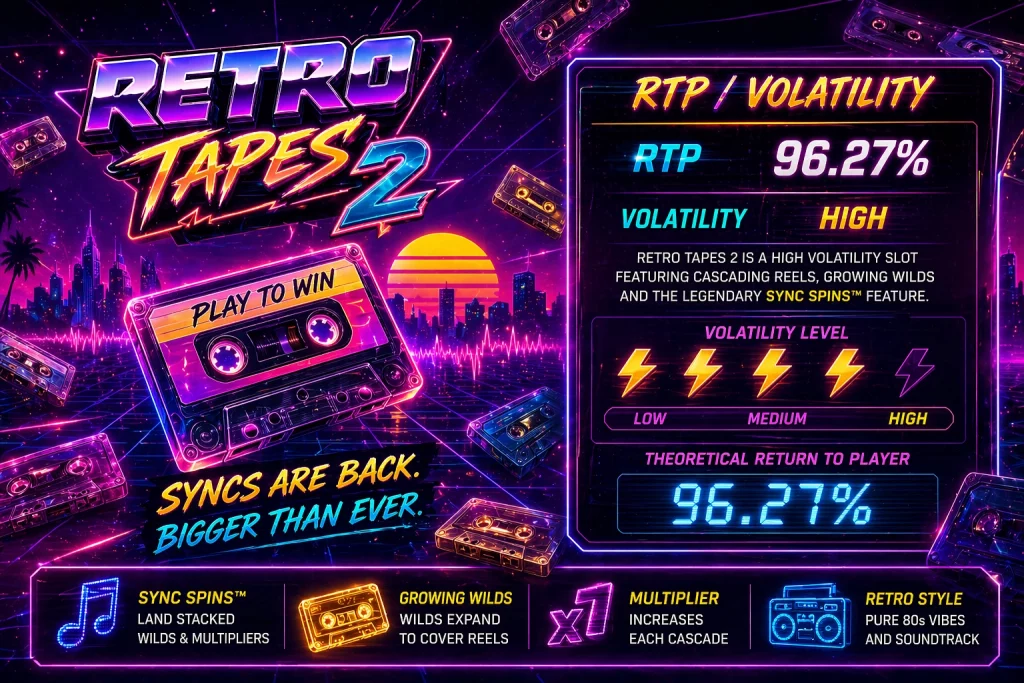
RTP (Return to Player) represents the theoretical percentage of all wagered money that a slot will pay back to players over an extended period, typically millions of spins. Retro Tapes 2 features a standard RTP of 96.40%, meaning that statistically, for every €100 wagered over the long term, approximately €96.40 is returned as winnings. The remaining €3.60 constitutes the house edge.
It is critical to understand that RTP is a long-term mathematical average, not a short-term guarantee. Individual sessions will deviate significantly from this percentage. High-volatility slots like Retro Tapes 2 often return far less than 96.40% during dry base-game phases, only to approach or exceed it when the Mixtape Bonus activates and delivers concentrated payouts.
High Volatility & Win Distribution
Volatility measures the risk profile and payout distribution pattern of a slot. Retro Tapes 2 is classified as high volatility, which fundamentally shapes how wins are distributed across your session:
RTP Configurations & Operator Settings
Like many modern Push Gaming releases, Retro Tapes 2 may be offered in multiple RTP configurations depending on the casino operator, jurisdiction, and commercial agreement. Common variants include 96.40% (standard), 94.50%, 92.30%, and occasionally 87.50%. The mathematical model and volatility remain identical across configurations — only the theoretical return percentage changes.
How to verify your active RTP: Open the game’s information or help menu, navigate to the paytable or game rules section, and locate the RTP percentage. Licensed operators are required to display this figure transparently. Always confirm the active configuration before starting a real-money session.
Where the RTP Comes From: Base Game vs Bonus
Understanding how RTP is distributed between base play and the bonus round explains why Retro Tapes 2 feels so different from medium or low-volatility slots. The mathematical allocation typically follows this pattern:
| Game Phase | Estimated RTP Contribution | Payout Characteristics |
|---|---|---|
| Base Game | ~30–40% | Frequent small-to-moderate cluster wins, sustains bankroll, rarely exceeds 10–15× stake per cascade chain. |
| Mixtape Bonus | ~60–70% | Sticky symbols, accumulating multipliers, and magnet pulls concentrate returns. Capable of 100×–10,000× outcomes. |
Session Planning for High Volatility
High volatility requires deliberate session structuring. The following principles align your bankroll and expectations with Retro Tapes 2’s mathematical reality:
Reserve 200–500× your base bet per session. This provides sufficient spin count to navigate natural dry periods and reach the statistical bonus trigger range.
Lower bets extend playtime but reduce absolute bonus payout scale. Higher bets increase potential returns but deplete funds faster during variance swings. Choose a level that balances both.
Define a maximum loss limit (e.g., 50% of session bankroll) and a realistic profit target before spinning. High volatility can erase bonus gains quickly if played without boundaries.
Increasing bet size to “force” a bonus or recover losses disrupts bankroll sustainability. Trigger probability remains fixed regardless of stake or spin count.
Testing Variance in Demo Mode
Because RTP and volatility are long-term mathematical concepts, short demo sessions will not perfectly reflect theoretical averages. However, playing in demo mode remains the most effective way to observe how variance manifests in practice. You can experience extended base-game dry spells, trigger the Mixtape Bonus with virtual credits, and watch how accumulated multipliers and sticky symbols alter payout distribution — all without financial exposure. This builds accurate expectations before transitioning to real-money play.
RTP & Volatility Summary
Regulatory & Responsible Gaming Resources
Players who want to verify licensing standards, payout fairness, and responsible gaming practices can refer to the following international regulatory and support organisations. These independent bodies oversee casino operations, enforce compliance requirements, and provide resources that help ensure transparency, player protection, and fair gameplay conditions.
Frequently Asked Questions
RTP and volatility are the mathematical foundations that shape every session in Retro Tapes 2. The 96.40% standard RTP reflects long-term theoretical return, while high volatility explains the uneven distribution of wins across base play and the Mixtape Bonus. By verifying your active RTP configuration, planning bankroll allocation around 200–500× your bet, and treating dry periods as normal variance, you can approach the game with clarity and control. For players who want to observe how these mathematical parameters manifest across actual spin sequences, the demo version provides a risk-free environment to test expectations. For deeper technical insights into how cascades and special symbols drive the payout structure, the mechanics section covers every system in detail.